

SafetySustainability
Safety Philosophy
The Mission of the JERA Group is to provide cutting-edge solutions to the worldʼs energy issues. To fulfill this mission, it is essential to conduct our business activities safely and supply energy in a stable manner
To that end, the JERA Group will develop its business activities based on the premise of “Safety First" in its entire supply chain from fuel upstream investment/procurement to sales, and will work on further safety measures to ensure that everyone in society can have peace of mind.
Safety Policies
Based on the Safety Philosophy, the JERA Group will work on the following policies:
- Create a safe, healthy and comfortable work environment.
- Observe safe and appropriate operating procedures and rules.
- Design, operate, and maintain facilities with safety in mind.
Principles of Conduct
To realize the Safety Philosophy and the Safety Policies, each and every officer and employee will act in accordance with the following principles of conduct:
- Work together across organizations and responsibilities to ensure safety.
- When in doubt, always choose the safer option.
- Make continuous efforts and initiatives to ensure safety.
Fundamental Approach

Safety: The Highest Priority in Everything We Do
Our mission is to provide cutting-edge solutions to the world's energy issues. Power generation and fuel facilities operate under high pressures and temperatures, handling many hazardous materials. It is essential to eliminate accidents among all personnel involved in facility operation and maintenance and deliver energy in a safe and stable manner.
That is why we operate on the basic premise of safety first throughout our supply chains, from upstream fuel procurement to electricity sales, in accordance with our safety philosophy.
Safety Activities Reaching All Involved in Our Operations
They require the collaboration of group and partner companies in the workplace, which is why our safety activities cover everyone involved in the JERA Group's operations. As the business domain grows, we intend to expand our business areas including those overseas, all while giving the highest priority to safety.
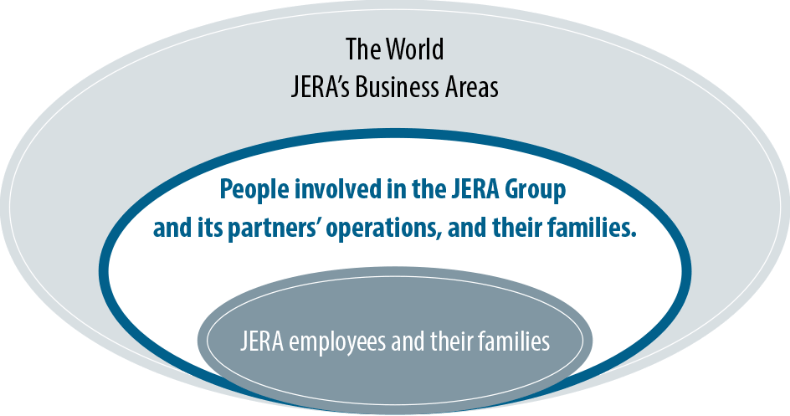
Working with Group Companies and Partners to Foster an Integrated Safety Culture
Realizing our safety goals means making sure everyone involved in the JERA Group's operations is aware of safety as the highest priority, including at our group companies and business partners.
The JERA Safety Vision was established to give everyone, regardless of nationality, race, or affiliation, the ability to talk about safety goals using a common language. We are also developing activities to build a culture of safety that brings JERA employees together with everyone from group companies and partner companies.
In Pursuit of Zero Accidents
Taisuke Yokota
Senior Managing Executive Officer
Chief Business Support & Solutions Officer (CBSSO)
Safety is the foundation of all of our business activities. Our company is currently operating globally, involving culturally diverse people in its business activities. We are also exploring the use of new technologies like ammonia and hydrogen fuel. In such a work environment, it is crucial to identify, evaluate, and mitigate potential risks to create a safe workplace.
Taking into account the cause analyses and recurrence prevention measures following the 2024 fire at the Taketoyo Thermal Power Station and the fatal accident involving a subcontractor worker at the Hirono Thermal Power Station, we are currently advancing a range of initiatives. These include building a mechanism for encouraging people to speak up about safety concerns, formulating a health management policy to ensure worker health and safety, and creating a framework for making investment decisions necessary for safety measures.
We are also developing a risk-based global safety management system using the Three Lines Model that clarifies the roles and responsibilities of each organization.
Through these efforts, we will further enhance the effectiveness of our safety measures so that everyone who works at our company can work safely, and we will steadfastly pursue initiatives aimed at achieving zero incidents.
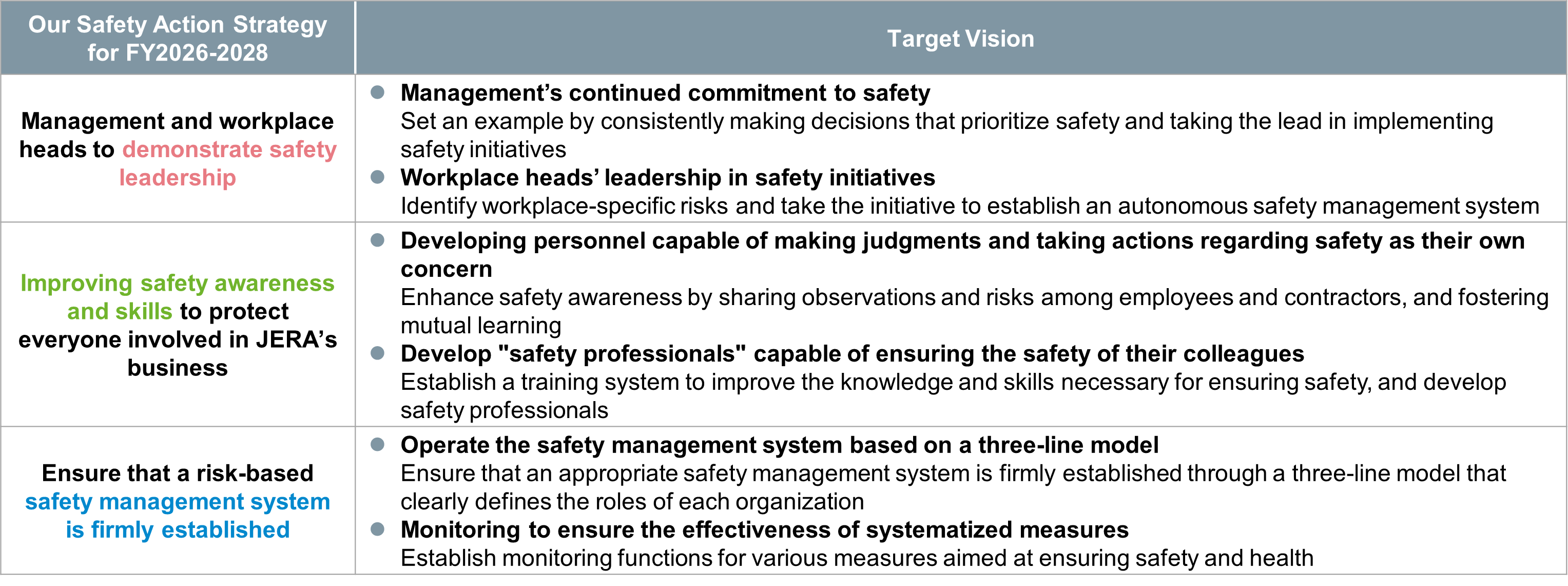
Our Safety Action Strategy
Formulating and Implementing Safety Action Strategies to Realize Our Safety Philosophy
In FY2021, we underwent a safety activity assessment by the third party and received recommendations focusing on leadership, organizational structure, and business operations for improvement to realize our safety philosophy.
Based on this assessment, we formulated the Safety Action Strategy (FY2023 - FY2025) as our medium-term safety strategy and implemented initiatives accordingly. In FY2025, we conducted another safety activity assessment by the third party. We evaluated our past initiatives and formulated a new medium-term Safety Action Strategy (FY2026 - FY2028). From FY2026 onward, under this strategy, each department develops annual action plans and steadily implements safety initiatives while driving continuous improvement, with “zero fatalities” as the primary safety KPI. The progress of the Safety Action Strategy, safety action plans, and KPI performance are reviewed in the Safety Manager Meeting, which includes participation from senior management, labor union representatives, and external experts, and are then reported to the Board of Directors.
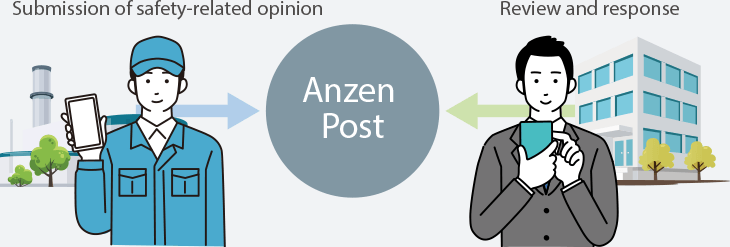
Featured
Anzen Post
Safety Promotion System
Establishing of a Safety Promotion System with Management Participation
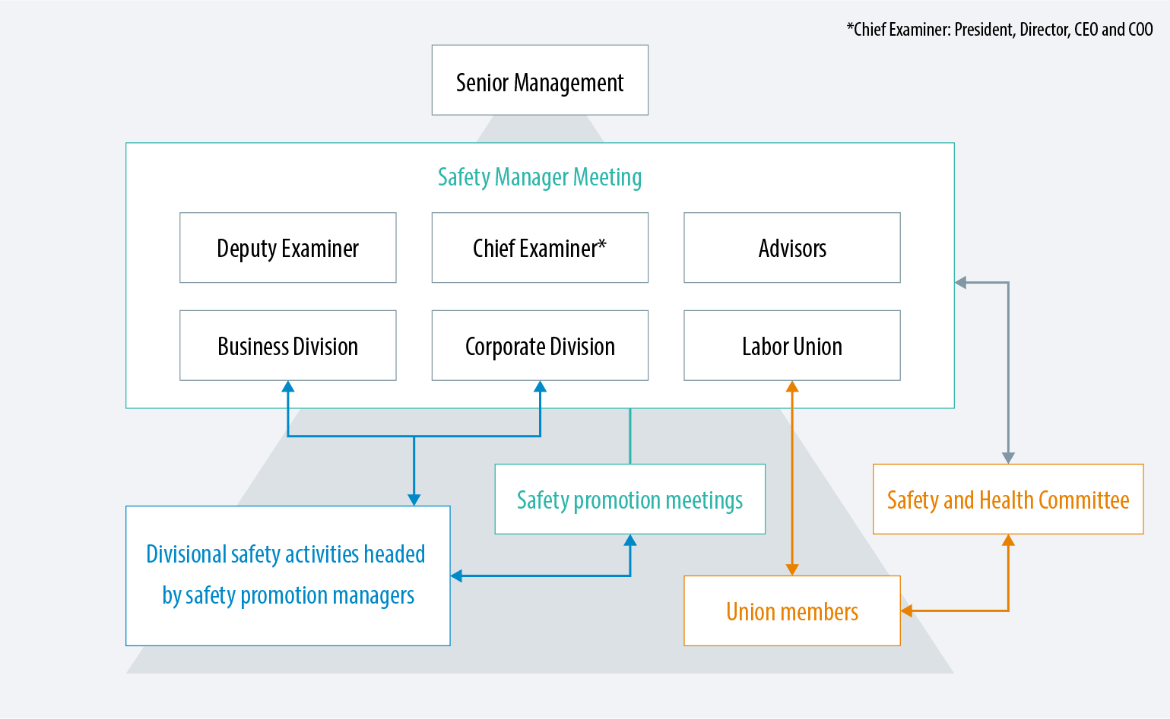
We have established the Safety Manager Meeting, which is chaired by the President, Director, CEO and COO and attended by CXO, labor union representatives, and external experts. Discussions on JERA’s safety occur under this framework, departments carry out safety activities to promote unified safety efforts company-wide. The key discussion points from the Safety Manager Meeting are reported to the Board of Directors on a quarterly basis.
Going forward, we will strengthen our safety promotion system based on the Three Lines Model by clarifying the roles of both site-based and headquarters-related organizations, thereby intensifying our efforts to advance safety.
JERA's Safety Promotion Structure (as of April 1, 2026)
Pragmatic Discussions at Safety Manager Meeting
In addition to management, labor union representatives attend the Safety Manager Meeting as employee representatives, while external experts participate as advisors, providing third-party perspectives on our safety practices. In FY2025, the meeting was held six times to discuss specific measures for achieving zero incidents. Topics included investigating the causes of accidents that occurred during the year, assessing the effectiveness of recurrence prevention measures, and examining the establishment of design safety guidelines for facility installation and removal.
Accident Prevention Efforts
Expanding Integrated Safety Activities in Japan and Abroad to Ensure Zero Accidents in the Workplace
At our overseas power plants, we also implement safety activities tailored to each workplace while complying with the safety laws and regulations of each country and region.
We will continue to share safety initiatives from these diverse workplaces internally to establish common codes of conduct for the entire JERA Group.
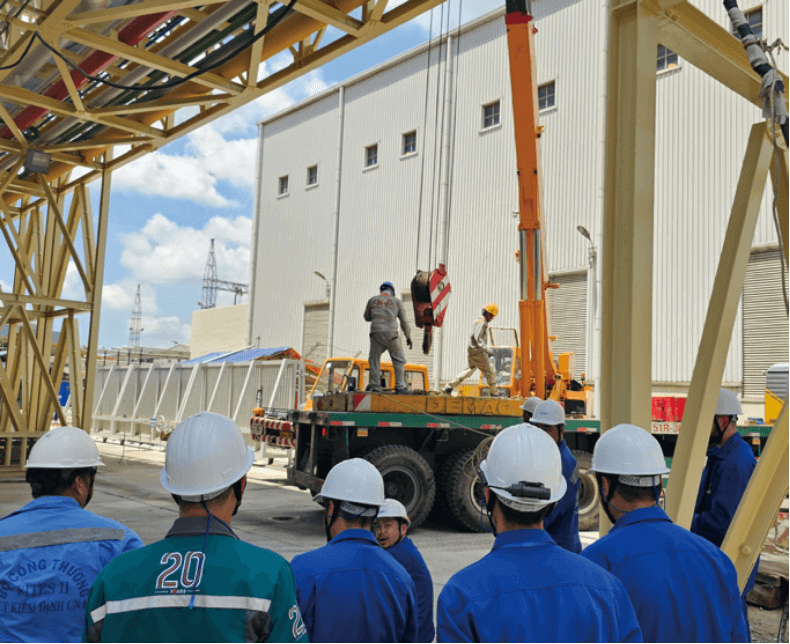
Safety patrol at Mekong Energy's Phu My 2.2 Power Plant (Vietnam)
Facility Safety Measures for Emergency Readiness
We must be able to bring facilities back online quickly, even in the event of natural disasters or other major emergencies. We, therefore, manage our thermal power plants appropriately in accordance with all relevant laws and regulations, and conduct drills and training in cooperation with local communities to be fully prepared for any emergencies.
Earthquake Countermeasures
We design and build new thermal power plants in keeping with all relevant earthquake laws and regulations, as well as the Japan Electric Association Code (JEAC), and conduct periodic facility inspections after completing construction to ensure earthquake resistance. In addition, we take into account any earthquakes announced by official government bodies such as the Cabinet Office, evaluating the seismic resistance of key facilities and implementing measures such as seismic reinforcement to avoid long-term shutdowns due to damage or destruction.
Whenever earthquake predictions or other new information becomes available, we will act on these insights to assess the adequacy of our current earthquake preparedness and implement any required measures.
Safety Measures in LNG Handling
Our thermal power plants and LNG terminals handle vast quantities of LNG, so in preparation for the unlikely event of an LNG leakage, we implement safety measures based on the following three concepts: (1) leakage prevention, (2) early leakage detection, and (3) prevention of leakage expansion. We also make considerations for the handling of fire. For example, we adopted explosion-proof structures for electrical equipment surrounding LNG facilities and restricted the use of products that might cause fire by designating control zones.
Safety Record
Establishing "Zero Disaster-Related Fatalities" as a Safety Target (KPI)
We have set “zero disaster-related fatalities” as a KPI and carry out a range of safety activities in line with our Safety Philosophy.
The number of incidents in FY2025 was 32.
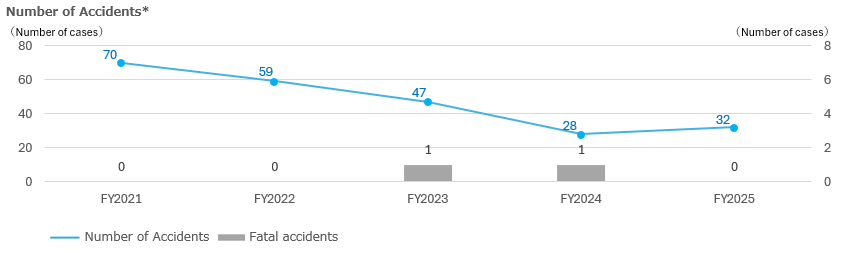
Note: “Accident” refers to any injury, illness, or death arising from our business activities and affecting officers or employees of our company, our affiliates, contractors or subcontractors commissioned by our company or our affiliates, or members of the public. Cases of injury or illness are limited to those that have received treatment by a physician. With the revision of the scope of accidents to be reported and compiled in-house beginning in FY2024, the following will be included in the accident count until FY2023, but not from FY2024 onwards.
・Mild (Grade I) cases of heat-related illness that did not require treatment by a physician
・Injuries and illnesses among individuals other than our officers and employees that result from work (including construction) conducted or commissioned by our affiliates.
Investigating Incidents Related to Occupational Accidents When They Occur
When a labor-related incident occurs, we first provide aid to the injured and implement measures to prevent secondary disasters. We then conduct an investigation and analyze the causes according to the following procedures, followed by implementing measures to prevent recurrence.
