

LNG Bunkering Vessel “KAGUYA” Completes 200th Ship-to-Ship LNG Fuel Supply Operations2026/10/08
JERA Co., Inc. (JERA) and JERA Global Energy Solutions Pte Ltd. (JERA GES), JERA’s exclusive platform for long-term LNG and lower-carbon fuels portfolios, today announced that the LNG bunkering vessel KAGUYA has completed its 200th ship-to-ship LNG fuel supply operations.
KAGUYA is owned by Central LNG Shipping Corporation (“Central LNG Shipping”) and operated by Central LNG Marine Fuel Corporation (“Central LNG Marine Fuel”), joint ventures in which JERA GES has invested.
On September 30, 2026, KAGUYA supplied LNG fuel to SWEET PEA LEADER, the car carrier operated by Nippon Yusen Kabushiki Kaisha (NYK Line), at Mikawa Port. This operation marked KAGUYA’s 200th ship-to-ship LNG fuel supply operation. The vessel has also maintained accident-free operating record since commencing service in October 2020.
KAGUYA was the first LNG bunkering vessel to commence operations in Japan. Since entering service in October 2020, the vessel has been passed at JERA’s Kawagoe Thermal Power Station and operated by Central LNG Marine Fuel.
Through Central LNG Shipping and Central LNG Marine Fuel, JERA GES will continue to enhance LNG bunkering services and support a stable LNG fuel system in the Chubu region, helping to expand the use of LNG as a marine fuel and reduce environmental impact of maritime transportation.
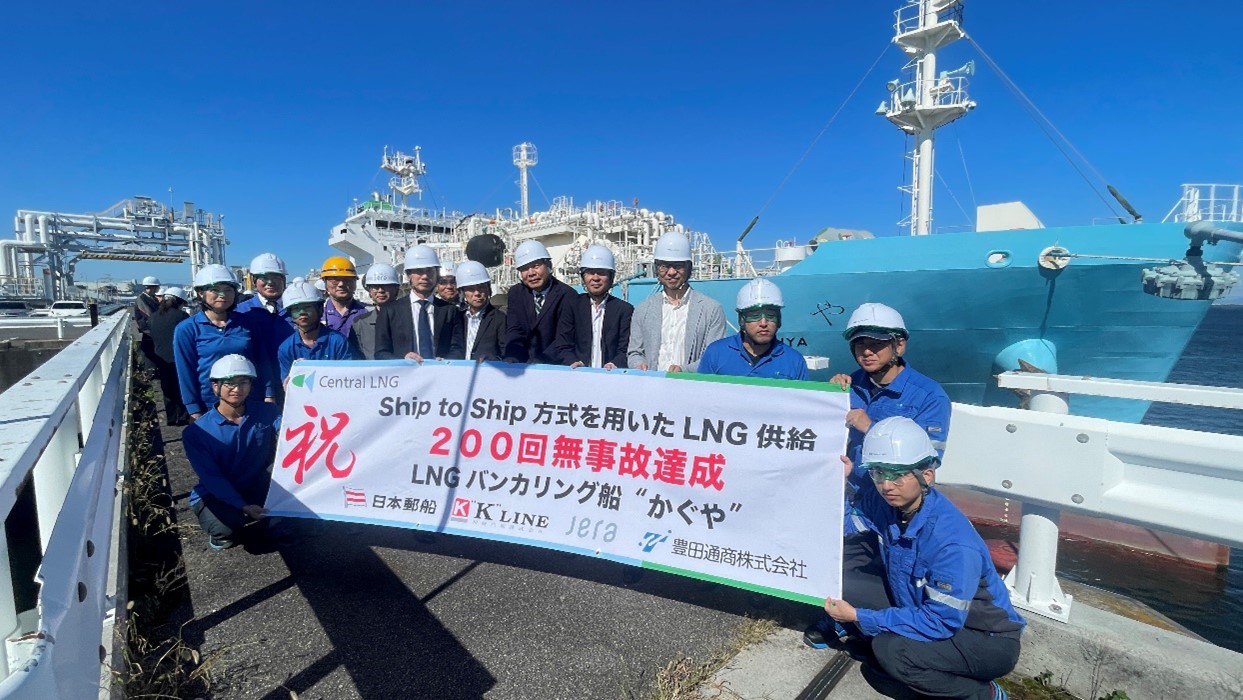
Vessel Specifications: “KAGUYA”
LNG cargo capacity 3,500 m³
Gross tonnage 4,044 tonnes
Length overall 81.7 meters
Beam 18.0 meters
Shipyard Kawasaki Heavy Industries, Ltd., Sakaide Works
LNG Fuel Supply Framework
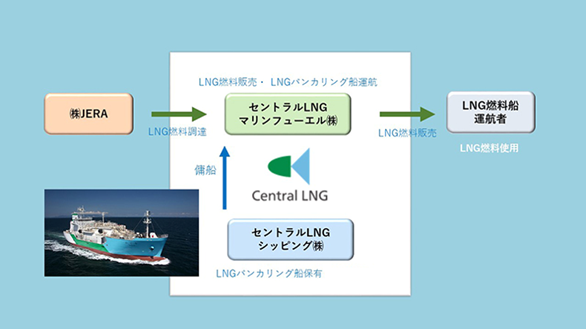
*1 Ship-to-ship method: A method in which an LNG bunkering vessel comes alongside an LNG-fueled vessel moored at a quay or pier, or at anchor, and supplies LNG fuel.
*2 Characteristics of LNG fuel: Compared with heavy fuel oil, LNG fuel is expected to reduce emissions of sulfur oxides (SOx) and particulate matter (PM) by approximately 100%, nitrogen oxides (NOx) by up to 80%, and carbon dioxide (CO₂) by approximately 30%. It is regarded as a leading alternative marine fuel to heavy fuel oil in response to increasingly stringent international vessel-emissions regulations.